No questions Social Media has more “likes” than a gaggle of gossiping girls squawking over lunch at the mall. Have they become so ubiquitous and omnipresent that they are merely feckless notations we gloss over on posts and pages? What’s your criteria for clicking your mouse on the little like button and do your likes matter?

To my ear it sounds pretty lame to hear a big advertiser elatedly plead, “Like us on Facebook!” Seems a little desperate and given a command for lemmings to march what value would a hundred or thousands of likes have? Do likes matter to entrepreneurs or small business? What about to already shared posts or political comments? Most important what does a like say about you…and will you like that?

Here’s a few suggestions for where likes do matter:

  • Your connection’s posts – By no means should you blindly like anything you don’t read but those of us who count on demonstrating expertise in articles we write or posts we share need numbers. When you like something your action is generally displayed to your network and that builds the views and potential impact for the post. Your like shows others you not only care for what was posted but that you are willing to help them spread the word and it’s generally very appreciated.
  • Give to get – That’s a credo for life and anyone who lives on referrals knows it is sacred scripture! Even if you are an occasional sharer of comments or articles you’ll surely value the affirmation knowing your share mattered and when you like things done by others they notice your action and are often willing to reflex back in kind helping your post also be more noticed and impactful.
  • Small Business – Very few small businesses have large advertising budgets but most today believe that having a Social Media presence is something they need to do. Some do it well and with style, others are perfunctory. Regardless of the content quality if you have an experience with a business that you appreciate, value or would recommend then by all means share a like (if not a more active positive review somewhere.) Not only will the business appreciate it but so might your network should they be in the market for the same service.
  • When it’s the truth – Going to a big advertiser or product’s pages to like is hardly a priority in anyone’s life but if you have a positive message to convey about a product or service then hit the button, goodness knows there’s enough negative comments out there, maybe you’ll be bringing some balance back to the universe!

What about Politics, are you kidding?

It seems nothing gets the room divided more quickly than politics these days. Should you go ahead and like your candidate, your issue? Transparency and seeking out like minds is certainly a bonding strategy so long as you are comfortable with the alienation that may also accompany it.

If you are seeking a job or clients then be aware that others are able to view your liking so you will likely be profiled for your likes. What if you like something that turns out to be fake? Being supportive of charities or bi-partisan issues is surely a positive. You can certainly be partisan but it is highly recommended that you like things that are positive for all as opposed to divisive. Liking a comment that chastises divisiveness is also a good like light to shine on yourself and comments for civility and inclusion are nice adds to your personal brand?

For most people in business it is best if people are unable to tell your politics by your social media history…unless you only want to be with one clear or narrow team. So go ahead and like to like what you like, if you don’t like your likes being disliked then beware the like…and if you liked this article…please, please like it! I’d like that.

© MyEureka Solutions 2017

Tagged with: , ,

“Good idea! So when should we do this?” How many times has an agreement on a productivity improvement, a process change, pursuing a new opportunity, buying or selling something been agreed but when it comes to the “when” answer it is general, distant or even vague? A process we teach called Trigger Metrics™ can get you to avoid the vague and initiate action.

Getting agreement or acknowledgement on what could be done to improve something isn’t uncommon. Good ideas get proposed, vetted and belief forms yet the time for action is often…not yet. So when? Soon, eventually, when the moon is in the seventh house? In our Time Management course we talk about simplifying your actions into “could do,” “should do,” and “must do” buckets. The primary difference being your “must do” activities require you to schedule them in a specific time, or window, on your calendar to act on it.

With bigger or more complex processes things that are moving from could do to must do in management’s belief find the “when” is often subject to things that don’t have a timeline or worse, don’t hold anyone’s feet to the fire for a commitment to specific actions. It feels supportive to agree with an idea and suggest that “eventually” that’s where you need to go. Feels like a vision for the future, but it ain’t a plan.

Our belief is to use Trigger Metrics™process to take care of the when and if to make changes. In summary, the process asks you to define the conditions under which a change makes sense to take place so you convert, “That’s something we should really do when we are a bit bigger.” To: “When our sales grow to $1.5MM and our margin remains at 24% or better Jane’s team will activate the new widget.” In short, requiring yourself to put metrics that activate actions promotes several key business objectives:

  1. Being specific rather than vague forces thoughtfulness and specifics and allows for agreement by taking generalizations to specifics and that allows everyone to understand the water line, so to speak.
  2. Tying actions to a set of numeric statistics or measurable conditions means you create commitment to action. The top reasons leaders fail to act on what they acknowledge they should is a lack of specific commitment.
  3. When you know something is going to be measured and an accomplishment, or lack of, will automatically initiate change you become acutely aware of all consequences.
  4. Trigger Metrics where actions are tied to measurable items creates Accountability, a key component of success in the highest accomplishing organizations and individuals.

Besides positive change initiatives negatives can also be predefined to avoid surprise. “If our sales drop below $5MM we will have cut staff by 2 people.” Consequences become clear so motivation is also easily stimulated.

The next time you hear or think that something would be a good idea to do, change, buy/sell, initiate down the line and the “when” is either not specific or not connected to an actual tipping point consider holding yourself to a new process. Use Trigger Metrics to figure out the when, or what needs to happen in order to catalyst change and take the guessing out of process improvement and the second guessing or rationalizing out of inaction. Set the conditions for change and when they occur have the courage of your convictions to follow through, act, and get it done.

Of course, if a new evaluation determines the initial metrics were incorrect or incomplete then acknowledge those factors and reset the metrics to a specific measurable and a reset specific action to follow. You may just find you are getting things done and maybe a little less worried that there’s so little time to act on good ideas.

Tagged with: , , , , ,

I can recall a time as a Sports Illustrated manager some years ago when I complained to my Director that it always seemed the person I had to deal with to resolve Editorial and Advertising conflicts seemed more intent on banging heads than resolving issues. I was told, to my amazement, the Managing Editor kind of liked it that way. He felt it was better to have people fight it out than to have one side become dominant and surrender too much.

Whatever argument you want to make about the value of “healthy conflict” I can tell you that I felt personally hit in the gut and it changed the way I viewed the players from then on. I strove for one team with one goal and mutually beneficial resolutions but it was clear above me was a “throw them in the pit and let them fight it out.” I felt I was less a loyal soldier and more a disposable gladiator. An exaggeration? Probably, but is there ever only one emotional response to conflict? So how do we best avoid conflict and if it is inevitable then how do we resolve it? The most unasked question however, what does conflict cost?

Let’s define conflict and not confuse it with healthy debate. Surely no leader benefits from prognosticating to a swarm of Lemmings but if the vision and culture is set in a clear, productive and healthy way then differences get aired, valued, tested, evaluated and none of that requires conflict. As a noun conflict is a serious disagreement or argument, typically a protracted one. As a verb it is to be incompatible or clash. Before suggesting a strategic overview to avoid and resolve here are three likely costs of conflict culture which can be individual or cumulative of all three.

  1. Efficiency Cost – Processes are designed to flow, if you picture them in a flow chart imagine the additional steps that resolutions require. Lots of Yes / No diamonds and arrows off to escalations and go-arounds to force things forward. When any process is delayed its efficiency is diminished and anything less than optimal has a price tag.
  2. Emotional Cost – Imagine your conflicts, most people want to avoid the stress, the gut ache or the sheer waste of time. Besides feeling ill effects and becoming less engaged, less effective, conflict discourages creativity. You can’t throw out a BHAG (big hairy audacious goal) to a team in conflict let alone a minimal goal. People will go out of their way to avoid conflict or in conflict there is no win-win, maybe a win-lose but more likely a lose-lose despite the outcome, decision or following action.
  3. Culture Cost – To have a high performance team you have to challenge them. High performers embrace challenge but few embrace conflict as a vehicle. Some do for sure, but look in their wake and you will see a path of destruction. This will drive away potential contributors and leave you with an Alpha and a team of timid survivors or worse, two rams regularly butting horns. What would that cost number be? If you said “a lot” that’s probably right.

Let’s accept that a Conflict Culture is likely costly in most professional settings. So long as you have engaged, enthusiastic thinkers who are also human there will surely be some sparks of conflict. That’s okay, occasional sparks can be overcome provided they don’t leave the earth scorched. Given that, we need a RESOLUTION strategy to put out fires and an AVOIDANCE strategy to make sure our resolutions are minimally required.

AVOIDANCE

Avoiding something as a strategy is better set by targeting what you want as much as what you don’t, how to get there and what the reward is for arrival without scars.

  • Set an example – the leader’s action are by far the best way to communicate. Embrace new ideas as good even if it’s clear they may not work, recognize when something is done the right way, reward partnerships and cooperation, promote team with examples and never make any of these things lip service or contradicted with “exceptions.”
  • Never disparage – Teasing can be a harmonious aspect of a culture but it often exceeds boundaries that aren’t always obvious or variable to people’s sensitivity. Sit in a meeting where praise dominates torment, where would you want to work?
  • Value diversity – A greatly underappreciated aspect of diversity is the differing nature of conflict across the human spectrum. While the perception of conflict can differ (“that’s just how we speak to each other”) the presence of diversity often brings a conscious effort to find the effective communication path or can be assimilated to a common good, not politically correct, economically correct.

RESOLUTION

It’s not unhealthy for conflict to arise but it doesn’t have to be inevitable. Should it occur it needs to be identified quickly and a leader should have a strategy for resolving. Here are a few examples:

  1. When You Do This I Feel That… This formula is a way to broker the peace. When accusations of actions occur then defenses go up, counter charges fly and people reach back to old wounds to reinforce their front lines. Make it clear that everyone is entitled to feel however they do, we don’t get to tell one what they shouldn’t feel. Facilitate communication by having people detail how the actions of the other felt to them. This direct intervention creates an empathy opportunity and allows a situation to be re-framed. If positions are hardened at least there is a forced awareness of the emotional consequences inflicted with an action and that same path is more likely avoided in the future.
  2. The Old Pro & Con… Something as simple as breaking down points of view into the good and the bad can avoid the ugly. After each side of each argument is detailed a higher level of detail can be extracted, long v. short term, cost of cons, potential of pros. It’s remarkable how making arguments visible with facts removes much of the emotion and the fear of hidden agendas or malice as a component.
  3. Mediate To Find Mutual Value… Taking time to mediate conflict is a commitment to be sure but helping people see the opposition point of view and urging them to find the value creates bridges to compromise. It is rare that any conflict is one sided so effectively (or professionally if it gets too messy) mediating conflict more often brings a better result by discovering value and appreciating the shortcomings.

Finally, don’t tolerate those who can’t be productive without conflict. Appreciate that there are emotional, cultural and true productivity costs to a culture where ideas and opportunities languish through the suck of conflict. Of course, the easiest way to resolve conflicts is not to have them. That won’t be an accident but it could be a goal.

© 2017 MyEureka Solutions LLC

Tagged with: , ,

There can be great leadership in powerhouse sports divisions…that’s not SCC. Neither is this program about Squamous Cell Carcinomas–but use sunscreen and see a Dermatologist if you’ve got one! The SCC is an acronym to guide great coaching, productive managing and enviable leadership. Regardless if you are leading a football team, diagnosing skin disorders, running your own company or managing a couple of employees following the SCC way might just get you to the winner’s circle for the trophy.

The best leaders all drive success with these core principles, they aren’t the only way but they may be the most efficient and mutually rewarding so let’s break them down. SCC stands for System, Connection and Consistency. Why does each matter and why do they need to be employed en mass?

SYSTEM, simply said is a set of principles and procedures according to which something is done; an organized scheme or method. The key here is that the guiding principles sync with requisite procedures. Procedures need to translate into behavior and if one of your principles includes accountability then the procedures will stay true to their purpose. The mistake often made is when leader’s allow their system to be the sum of their actions and decisions. Instincts rather than plans. That certainly is a system, but not a particularly efficient one.

  1. Determine your guiding principles and write them down. These can be values but also strategies from communication to delegation to review and reward.
  2. Make Accountability a core part of your system and determine how you will apply and measure it both to yourself and with all people and processes that report or roll up to you.
  3. Unless you are a covert CIA operative make your system known, obvious and lived as an example to all those who are expected to produce within your system.

CONNECTION, a relationship in which a person, thing, or idea is linked or associated with something else. I suggest determining your connection strategy with all three of those. How will you relate to people? Can you motivate, inspire, display empathy? Are you intimidating? It’s not so much you have to coddle or be loved but without connection people create their own directions and make assumptions about paths and processes.

  1. Get comfortable with how, when and why you will make personal connections with those who participate in your success. How personal/intimate are your connections?
  2. Don’t fake it, whether you are the strong, distant type or one to know everyone’s spouse’s name and their kid’s ages is not paramount, being true to yourself and how you comfortably relate to others needs to be the foundation of honest connections.
  3. Connect your connecting within your system. Have a plan to establish connections that fits within your System.

CONSISTENCY, conformity in the application of something, typically that which is necessary for the sake of logic, accuracy, or fairness. Of course you can be consistently unfair, inaccurate and illogical but you can probably see where that’s a leadership pickle.

  1. Determine if your System and manner of making Connections is logical and fair and then keep their application compatible with those principles.
  2. Rigidity isn’t necessary for consistency, demonstrating flexibility regularly when it is connected to logic and a justifying end goal can be recognized as a consistent trait. Either can work, again, if they are true to the system and connection strategy.
  3. Don’t do it one way because it’s always been done that way. Use consistency in positive attributes: open to new ideas, listens, talks through potential results, clear in decision making and communication. Innovate consistently within your system.

There are probably a dozen more exemplary leadership traits like clarity, communication, boldness, enthusiasm, innovative etc…but remembering an SCCCCBEI…could get a little hairy. To set your course as a winning coach, a productive manager, a profitable owner or an inspirational leader keep it simple and focus introspection on your System, Connections and being Consistent and you’ll like your odds at taking home the SCC trophy (Success Conquering Challenges).

Learn more at www.myeurekasolutions.com. Best of success!

Dreams, ambitions, personal progress…we all have them. For personal and professional development it can be a long and tangled string of could and should do’s. We often fantasize about the end state and get confidence that’s where the payoff is but for far too many of us it is the action steps to get there that we often don’t formalize, in short we have big ideas and little plans.

The first step in anything new to accomplish is usually the hardest. Often that step, while certainly being directional to aspirations, can be perfunctory or be a multi-task in requirement for many things not part of the “big plan” and we then excuse or rationalize away every oncoming distraction. So how do you get to the big there? A plan would seem obvious but having ideas in your head and actions written down on paper are not the same thing. (I’m also an advocate of writing in lieu of or before typing because there’s an emotional connection you don’t get with a keyboard.)

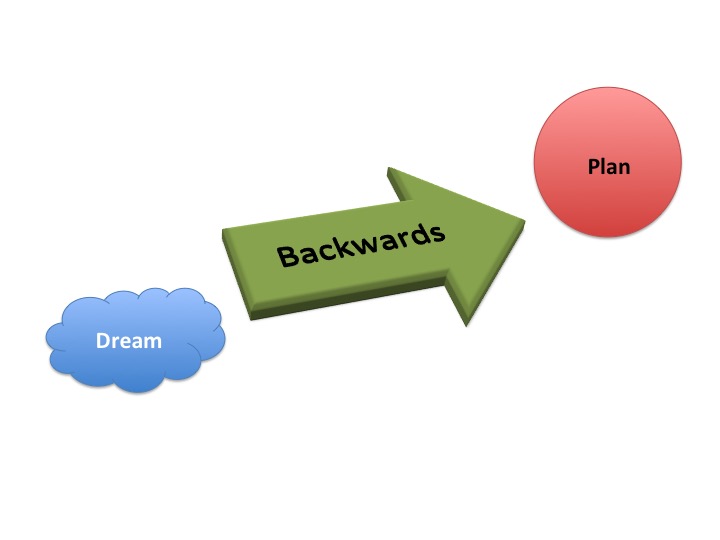
We face so many distractions and interruptions from immediate priorities that it is can seem flip to schedule yourself time to make a plan for something you really want. If we do get around to a plan the idea has usually been fermenting in our brain for some time. What if there was a practical way to not only get a plan done but to then act upon it? There may be, but you might want to try going backwards!

Sure, it seems counterintuitive as plans usually have completion dependencies to advance along a progress timeline but reality is that it is extremely hard to forecast steps into the future and can be highly distracting, derailing or redirecting and many actions end us up in a different place than thought because the circumstances of the moment seemed to chart a more urgent, logical, or perhaps less resistant path.

Happy accidents aside, it’s not the most efficient way to get to your vision. Working backwards provides the initial priority that it is the end state we are really striving for not the first step. There are usually many paths so it’s focus on the finish that counts. The more clear and specific we are about where we’ll end up better arms us agains falling prey to the distractions? Try creating a 5 step plan with five backward steps to make clear what your sequence needs to be. Here’s the outline:

  1. Formulate and spend time with your Vision of the End State goal, be it a position, a situation, a possession or a state of being or feeling. Identify in that vision why it makes you happy and what thing(s) are your real drivers of happiness. What is the potential downside of getting there? If your vision exercises leave you feeling happy about yourself it’s got good karma you’ll want to work for it and go to step 2. (If it leaves you anxious or uncertain move on the the next dream or come back to it as life evolves and see if your assessment changes)
  2. Visualize the specific effects of the accomplishment, of getting there. Many people use Dream Boards to hold images of the things they associate. It may be a picture of an opulent office, it may be a peer’s sign of respect or it may be an image of self satisfaction a vacation or a smile when the bills come due. The image doesn’t need to be a picture, it may be a quote or a few lines you write down that typify what you’d do or say or feel in your end state. Having set images for your brain to see reminds you of your initial vision otherwise dreams often involuntarily evolve or devolve–and sometimes go far astray of our true desire.
  3. Chart your helpers. None of us get very far on our own, at least not in isolation. If you are lucky you may have a champion or an advocate. You may have a spouse who inspires and supports you. Perhaps a team or a staff or a customer who respects your leaderships and wants to rise with your ship is willing to work in line with your dream. Write them down with two other columns answering, 1) Why do they support me, and, 2) How do I prove them right.
  4. Identify your dream killers. This might be your own propensity to procrastinate. Self or imposed fears of the unknown, or even of success. Competitors or grudge holders or proven volatility in markets, conditions or relationships. Don’t make it an exercise in paranoia but it is critical to be honest. Your dream is about to turn into a plan so accurately identifying both the helps and the hindrances will give you a reality base to progress through.
  5. Make an Action Tree. Try this backwards also and limit it to the 5 biggest steps. What will be your tipping point action that finally gets you to your vision? What key thing happened that enable that? What significant thing did you do to put yourself in position to advance your goal prior to that? What near term success gave you and others the confidence you could succeed? What do you need to do tomorrow to start the chain rattling?

You now have a high level plan and an untimed timeline that you can now put time ranges on. Even if the time estimates are off you can adjust those and stay true to the plan. You took 5 steps to get a 5 step high level action plan. Sure, there may be countless smaller actions you need to do in each step and the path is more likely crooked than true but now you have a clear map that you can update and annotate as fits your style. You know the actions you have to get to, you know who your helpers are and what negatives you need to avoid or overcome. Reminding yourself of the effects of the accomplishment provides the motivation and it should all lead back to the core vision and desire that started you on the path of accomplishment

Sometimes it can be pretty smart to look backwards to propel yourself forward. What’s better than getting to your dreams…and remember to enjoy it when you get there!

Tagged with: , ,

Over twenty five years at Time Inc. and American Express I spent more than my fair share of time with big consultants like McKinsey and Anderson Consulting. Big companies spend millions of dollars on big consultants implementing process improvements and new ideas. Most companies, and virtually all small companies don’t have that luxury but there is a way to extract the fundamental processes, apply them to your company needs and implement successfully. Not only are there modified applications to the analysis but taking some fundamental steps, and not skipping key ones, can offer success opportunity far greater than the shoot from the hip or hit and miss approaches that many lacking big consulting resources feel trapped in.

After my umpteenth big project engagement we figured out their essence: Send in a smart dressed, smooth talking, high priced partner to sell top management improvements in process, revenue or cost. He then comes back and introduce the “plan” to the stakeholder managers and brings with him a top project guy and lieutenants (who will actually do the work). When the project starts another group of eager young MBA’s who were underpaid and overworked (hoping to someday get to the next level) charts and documents ad nauseam transcriptions by the client’s staff what was being done, what the problems were, and ways to fix it. Then, after weeks or months, put it all in a fancy report with the partner finally re-appearing to present back what the rank and file mostly knew but the client executives now felt justified to believe and act on.

The big guys can afford the kind of minutia process documenting, modeling, flowcharting and resolutions to the dreaded Iterative Nested Loops. They also do add credibility to the improvement suggestions because unlike what many staff or managers suggest there was backup documentation, ie proof, of what was actually happening, how long it was taking, what it cost and then the re-imagined process change was likewise documented and measured in every new step in comparison to the old.

What small businesses, or big companies lacking resources can do is extrapolate some core principles to make the same mind of measured effort but without the excesses and overly thorough documentation that can be overkill when stakeholders do direct analysis, have some guidelines, use their gut and validate everything with measurement.

To accomplish this my small consulting company developed Rapid Process Analysis™ to do the core analysis without all the overhead. Applying this process requires a few key points:

  • Change requires a strategy, that strategy then requires tactics all to be documented if you expect them to be done
  • Flowchart at a high level current processes first (if you don’t know how learn, there are great tools on line or can be hired at a manageable cost) http://creately.com/blog/diagrams/flowchart-guide-flowchart-tutorial/
  • Don’t assume the solution or ideal new process before you document where things are, indexing the high level so you have simple references should you need to go deeper in detail in process steps, decisions, outputs or data interactions and keep it all organized
  • Measure the time and cost of the current process (or proposed if new)
  • Validate all your documentations and assumptions with stakeholders
  • Draw your improvement/new process juxtaposed to the current and demonstrate where the costs, timing or other improvements are coming from (Delta Analysis)
  • Measure everything, then measure some more
  • Use your documentation as the key reference both to explain the implementation and to analyze actual results v. projected, there will be bumps so be ready to react

Even doing the best job of analyzing, costing, planning and implementing is only a start. Rarely is an implementation a set-it-and-forget-it one so it’s only going to be as useful as it is sticky. The equally important consideration therefore is summarized in what we train as Sticky Process Change™ to give you the best shot for continuing success with your implementation. This system is well summarized in the three “C’s” we train as fundamental to sticky success:

  • Clarity: cloudy thinging or acting is a sure way to undermine success so be sure every implementation has SMART goals, clear objectives, honest assessments, and motivations and reinforcements that align with the objectives and goals.
  • Confidence: If you’ve been diligent in your analysis and documentation (no you can’t keep it in your head) you will have every reason to express confidence. You’ll need to beware the head-nodders who agree in public and undermine in private. Acknowledge the unknowns and Law of Unintended Consequences but suggest your preparation has you ready to adjust and honestly assess what’s working or not.
  • Commitment: might seem obvious but I’m regularly witness to business leaders who undermine themselves with a lack devotion to the implementation. To avoid that create a Behavior Plan to document what needs to be done when. People instinctively distrust change so emphasize the objectives and why they matter…and if you ain’t got it, don’t do it.

In summary, you don’t need big bucks and big consulting resources to make big, meaningful changes in your organization. With a little training you can learn the shortcuts without shortchanging analysis and specialized small consulting can bring you the same proportion of big results with great ROI. Change is going to happen, will you plan it, manage it and profit from it, or will change manage you?


Rapid Process Analysis™ and Sticky Process Change™ are trademarks of MyEureka Solutions LLC.

© MyEureka Solutions LLC 2017

Tagged with: , ,

I promise this isn’t political…except to appreciate that all companies have politics and young top performers, grizzled sage veterans and idealistic new entrepreneurs alike all have leadership aspirations. So what kind of leader are you fit to be?

No matter what your current evaluation of our Oval Office inhabitant pro or con, and clearly any reasonable, non-idealogue would agree there is certainly a mix, whatever proportion. It would also seem reasonable to agree that whatever your politics our current President’s experience dominating a business empire seems to have equipped him better to be a King, an assertion I’d bet even he would agree with (or no doubt would prefer).

Why not? Mel Brooks once famously repeated in a movie, “It’s good to be the King.” For the most part, it is. Of course the offset to absolute power is that if there’s enough dissension about your ending is likely absolute too. (Why Kim Jong-un has had his detractors killed first, right?)

Leadership, when it is closer to absolute would appear to be easier. At least more expeditious and maybe less contentious. With that power one is also less likely to attract or embrace opposing points of view, alternative approaches or dire predictions of the King’s actions. A president on the other hand is usually beholden to more influences from above, a CEO, a board of directors or customers (as opposed to subjects).

The fantasy of power, whether owning your own business or running a company or a division is about control and the endowment of your own opinion. It comes from the confidence that you either know better or are better suited to evaluate all opinions and choose the course. Perhaps you do or you can and that is certainly a primary element of success in leadership but even should you own a one-man-band of which you are president, believing you are (or should be) the king is equally a primary element for a very bumpy ride. LeBron James excluded.

If you are primed for leadership, a novice leader or even a seasoned captain it’s wise to remember some very different realities that a President might embrace to find success. Here’s my top 10:

  1. A King is often hailed as infallible and deified, a President benefits from humility and demonstrations of his or her own humanity.
  2. A King brushes away negative consequences and controls the perception through a forced narrative, a President lives by a scorecard of good and bad metrics described by others.
  3. A King’s authority is absolute, a President’s authority is built by creating consensus.
  4. A King’s subject loyalty is demanded, a President’s staff loyalty is earned continuously.
  5. A King’s mistakes are someone else’s fault, a President is accountable for results and actions alike.
  6. What a King desires is the law, a President acknowledges constraint of law.
  7. A King needs love from his subjects, a President needs respect.
  8. A King surrounds himself with figure heads, a wise President surrounds himself with strong leaders.
  9. A King makes his own agenda, a President serves the agenda of the constituency.
  10. Being a President is immensely difficult….heavy is the head that wears the crown, yeah but, “It’s good to be the king.”

So royalty is good work if you can get it, if you can’t and you are still looking to excel in leadership you’d do well not to confuse the two.

Tagged with: , ,

It is the nature of the beast for a business trainer and consultant to dwell on the negative. After all we make our money helping people turn bad news into good profit. Combine that with a hyper-awareness of the news and, even if you delight in the new direction of events, you can’t feel good about the divisiveness around almost every issue in our culture. We are embattled by wealth discrepancies, ideologies, theologies, geographies and demography…it can get downright depressing!

By contrast, a common trait found among successful CEO’s is a propensity to be involved in giving. It may be faith based or health cause related. It can be personal or community centered but there is usually a passion connection and that personality trait is part and parcel of the leadership profile that drives their success. I have counseled numerous CEO’s who are stuck or in a rut in their company to expand their horizons, connect to a charitable passion and see the returns roll in often unexpected ways.

Like so many I have done a variety of pro bono or charity activities and you recognize the giving/getting connection. I recall a friend who has volunteered and manages a soup kitchen every Saturday morning for years. I remember admiring her giving commitment but she made it clear though she was helping others she did it for herself. That confused me at first but then it made sense when you consider the Law of Attraction or even when you begin to grasp the mutual gain in realizing our better nature.

Surviving two kids through college and a little guy now in Kindergarten I’ve been through the mill of school events. Recently, our middle and high school took on the challenge of creating a TedX event for the students. Practically every professional has seen a Ted talk in some form and knows the power of the format. Taking a license to have students bring it to the community intrigued me so I volunteered to help the presenters with some of the presentation skills we teach to professionals.

I imagined I could help a little and our training certainly builds impact in presentations. Giving back to the community seems a worthy effort but isn’t it so often the case you get back surprisingly more than you give? The students here in Rye Neck, NY are surely similar to many high achievers in countless American schools. In their talks they are presenting subjects as diverse and important as the evolving role of women in culture, the value of classical music education, the Syrian refugee crisis, climate change impacts and the future of religion in our country. Heady topics to be sure and while their ideas can be intriguing it is their engagement that inspires. These are talented young people connected to issues with well thought opinions and a vital mix of realism, curiosity and idealism.

Being there to give my little bit I became inspired by the dedication and leadership potential in so many of our kids. I could imagine them going through college continuing as high achievers and finding their future professional pursuits all the while applying their ideals and enthusiasm to make a difference. So whatever short term angst our culture might be suffering that you might be sharing, my takeaway is that the future has all the potential for greatness and hope we need. It is wrapped and sometimes hidden from view in so many of today’s young people who will clearly be tomorrow’s leaders in achievement. That’s a takeaway you just don’t put a price on.


Tagged with: , ,

As one who has written many business plans and created or helped craft hundreds of goals it might seem antithetical to suggest that your best chances for success are not for your people to simply meet those goals or hit their plans but rather, when extraordinary things occur to propel accomplishment above and beyond “normal” expectation.

When others consider where you work there is often an instant reputation, sometimes a mystique about “the place” and that usually reflects the record of vision, insight and accomplishment, good or bad. Tell someone today that Google hired you and an almost instant label of talent, smarts and work ethic is pinned to your lapel. Having worked at Time Inc. for as long as I did I became used to a near instant respect, sometimes envy, occasionally awe at how we regularly moved the needle in our industry, how innovators, excellence and quality drivers flooded our ranks back in the day.

Reputations for a business are formed via a two way street of top down leadership and bottom up effort and innovation throughout. The question today is whether or not efforts that go “above and beyond” have become a requirement for “ordinary” success. Of course the definition of success and the cultural effort baseline are variable and one might argue that just doing what is asked can create plenty of success–assuming the right things are being asked! Unfortunately, business is tougher than ever. Leaders not only need instincts and skills to set the right goals and hire teams with the right stuff then motivate them the right way they need to understand generational influences, gender equality, labor compliance and technology to unprecedented degrees. The risks are higher than ever and the rewards harder to reap.

So what of setting out good goals and managing to measurement, isn’t that enough? Perhaps the simpler understanding in the marquee companies both present and past is that their culture inspired, perhaps required, and rewarded those who would contribute above and beyond. Sure, every team has its stars and great teams generally have better players. Does that mean without a full roster of stars you should accept a level of modesty in your success aspirations? Or is it more likely that what distinguishes great leaders and managers is their ability to nurture performance aspirations, recognize inspirations and meaningfully reward the efforts to make going above and beyond a broad norm for all rather than the exceptional reality of the few?

Selling more, spending less, better utilizing technology, innovating processes, incorporating diversity in all its iterations and then making a show of it for all to find pride, inspiration and reward is hardly a new concept. Perhaps the breadth of that requirement for predictable and repeatable success today is!

It behooves all leaders bent on finding success to codify and reach deep into the culture to recognize and reward the above and beyond efforts, ideas and innovations and make them repeatable and expected in the company and in themselves. That means different things in different industries and different job levels but it is the same thing in all people to appreciate there is doing less, doing what is required or doing more. When doing more or better or faster is what people want to do at work, when reinforced with recognition and reward, goals may no longer be seen as stretches or hopes or wishful thinking. They become a glass ceiling that the company takes as a challenge to always bang away at and regularly blast through.

Consider how your company recognizes and rewards those who go above and beyond. Are they inspired or encouraged to do so? Are the rewards meaningful? Is the recognition a source of pride and motivation? Is it the hope of the masses or the fiefdom of the few? To achieve success commensurate with the business challenges of today you might want to think of “above and beyond” as a requirement to set everyone shooting for the sky rather than being the provenance of a few scattered stars.

Tagged with: , , , ,


Whether you agree with the President that he’s the smartest, greatest leader ever or feel adamantly opposed to his every utterance there are a few things we can probably all agree upon:

  1. Social Media now seems to have ever more rancor than civility at posts and points of view.
  2. Friendships and perceptions of people have had many bumps and bruises through political, religious and social commentary.
  3. Whether you support or reject something political, religious, even sociological no one would likely suffer from one day with NO posts, tweets, videos or commentaries on said topics, with rancor, self-righteousness or obnoxiousness, absent across the social media spectrum!

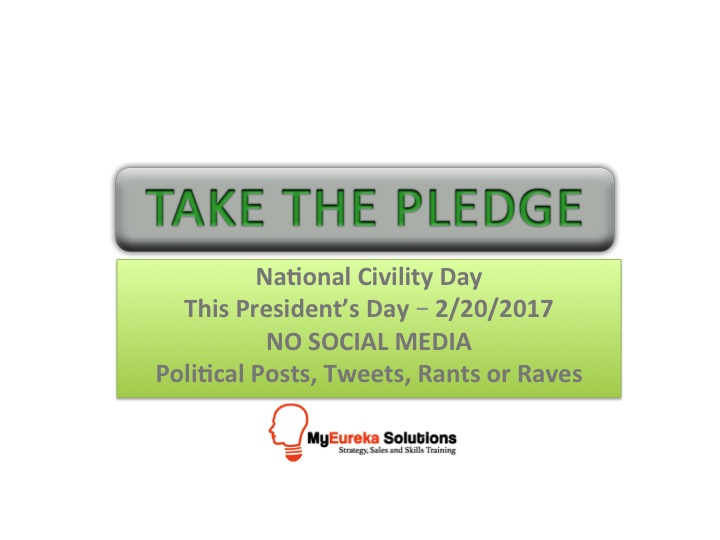
SIGN THE PLEDGE!

Perhaps it’s more metaphor than document but what if everyone agreed that on President’s Day we will avoid the political? If we avoided giving the world the indespensible value of our opinion and had nary a negative thing to say about anything we post or comment on? Share this and request the day if you agree!

Ahhhh, what a wonderful world it would be. The day after President’s Day return to your soap box, your semi-bully pulpit and set yourself up for all the un-friending you’ve rationalized is really what you want anyway or telling yet another Bozo that Linkedin isn’t Facebook… But on February 20th, 2017 pledge to honor what we can agree has been great in our country with a 24 hour break from our efforts to make it great again, convince people it never stopped being great, or deciding every political or religious act or comment is bring us closer to the end of the world as we know it. Let George and Abe have a day when their poor corpses aren’t spinning quite so hard in their graves. If you want to be critical find a mirror and make an action plan to be better!

On that day tell us what your family is doing on the holiday, what moves or inspires you (that isn’t political) and if you do by chance read or see something that rubs you the wrong way use your discretion to ignore, move on and find something to smile about. Let’s take a national holiday from anger, hate, vial commentary and for just one day be Pollyanna’s shining hilltop. If you’re one of those zealots don’t watch any news either!!

So take the pledge for 2-20-17, or you know, leave nasty, hateful comments below if you disagree…

Tom Fox