Any business person with a client to cater to has more than likely fantasized about firing their client on occasion. Damning the money and charging away from the aggravation with a one-finger salute. Usually those fantasies come when you are being yelled out on the phone or by biting email or maybe being shamed publicly. Despite the fantasy the usual response is to bite your lip, apologize then hold your tongue save asking how you can make it right. Ouch!!

Yeah, sucks to be you when that happens but a client means billing and we need money. Maybe we get lucky and they decide to fire you so you can say, “I respect your decision.” Then you hang up the phone or hit reply on the email crack a big smile, shout a “good riddance,” or maybe a fist pump and team high five. So, if you hated working for the client, you can survive the loss, why didn’t you fire him? Well, it’s just not done!

No, it’s not done very often. Besides forsaking billing there may be a sense of martyrdom or an acceptance. In The Big Chill the “square” advertising guy expounding his befuddlement at a suicide rationalizes, “You have to put up with some crap at work or with a client, but you try and minimize that stuff and do the best you can. Nobody said it was going to be fun…at least no one ever said it  to me.”

Fair to say it is cliché to expect that having a client inherently means you have to put up with crap. To some extent that may be true but there are limits, some obvious and some more subjective. Sometimes communication can smooth out a rough start or sometimes actions or consistency informs you need to fire your client…

WHEN: (Definitely)

  • You are asked to do something illegal and the client is aware of the illegality
  • You are asked to violate your moral or ethical standards and after explaining why you can’t you get insistence
  • You discover your client is involved with illegal, immoral or unethical practices regardless whether your work is directly linked

WHEN: (Probably)

  • The work you provide is not aligned with your strategy, whether as a legacy or an outlier
  • After analysis you aren’t profiting from the work, the client won’t accept appropriate rates and your affiliation is not providing a referral stream or other financial worth
  • The money you are making is not worth the stress you are enduring
  • Whatever the money you just don’t feel right and commit to replacing the billing with better fit client(s)

Sure, not everyone has the luxury to choose stress-free clients, maybe they don’t exist, but just as a business needs great employees who are aligned on message and giving quality effort so too does it require clients that align with the mission, help forward the goals, provide mutual benefit, and is not destructive to morale, morality…or sanity.

HOW:

Forget the Apprentice board room fantasy of surrounding the client with judges and opinions and issuing a Trump-ian “You’re fired!” or standing before the mob and turning a Caesar-like thumbs down. As the wicked witch of the west suggested, “These things must be done delicately,” never in anger and never without an explanation.

  • A high level, peer-to-peer, discussion of the circumstances and the suggestion, “Maybe we’re not the best fit” is as aggressive as you should go a need to disengage
  • If the discussion leads the client to believe they are firing you, swallow the ego and take the win
  • Come to the “firing” with some suggestions on alternatives for them (maybe referring a competitor you don’t like…or honestly thinking of a better fit).
  • Keep the bridge from being burned down, the win for you is getting away from the work not gloating in lancing a professional boil

Your reputation is on the line with how you fire as much as it is with how you work. Doing this on behalf of your staff can, and should, be presented to them as a supporting gesture. However, make it clear that having to fire a client is also a failure on your part and you need to take lessons from it. Maybe that is in doing a better job of vetting opportunities, maybe more clarity in pursuing strategy over dollars, maybe in better recognizing your strengths to exploit and your weaknesses to either develop or keep disengaged.

Bottom line about every bottom line is that you, and all employees, should be allowed to work and have the opportunity to grow and prosper in an environment of growth, partnerships, reciprocal value, ethical practices and the pursuit of success without a toll that negates that joy.

© 2018 MyEureka Solutions LLC.  Follow Tom on Twitter @TomFoxTrainer or for more business therapy articles www.myeurekasolutions.com/thoughts.

Tagged with: , , , , ,


Among the most common complaint of people in business is that it feels like there’s never enough time. There are battles between good intentions and procrastination (or prioritization if you think you’re not procrastinating). We know we need to be accountable but few people have a structure for Accountability, only consequences.

            For good intentions, most of us know things we could do and have some stronger feelings about what we should do. Generally, we get done what we must do though sometimes our “musts” are often left to the last minute.

For procrastination, you may be lazy, unmotivated or a charter member of the “too many distractions” club! You may avoid doing certain things for any untold number of reasons, rational or subconscious, there are myriad reasons our intentions and actions don’t end up in alignment.

In Time Management training we go deeper into the causes and defenses for distractions and prioritization strategy but even with all that knowledge success comes down to one thing: You have to do the things that need to be done! The strategy for that can be summed up in one word: Accountability. We appreciate taking responsibility for our responsibility but most of us find rationalizations, excuses or reasons why things don’t get done. The curse of self is that no matter how strong or independent we are in thought and action almost all of us benefit from a team structure of some kind. Like herd animals we evolved into communities for a reason. Think of how many social, professional and informal groups you belong to.

The success saving marriage of community and the task of doing is an Accountability Group or having an Accountability Partnership. This is a commitment of 2 or more people to share what they know they need to do for success, declare their commitment then account for their actions.


How It Works

Whether you have one Accountability Partner or a group (3-5 ideal) the structure is the same. The participants make it clear to each other what their definition of success is. That is accompanied by “why” it matters to both identify the motivations and show the stakes. The goal is to lift everyone by feeling compelled to their own commitments, it can’t be a group bitch session with sympathizers enabling procrastination, maybe to commiserate their own yet it is not judgment, so unlike talking to your boss (even if that’s you), you don’t have to lie.

Once there is clarity on success and motivation there needs to be required actions identified and shared that are critical components of that success. These actions should be identified in quantity and be put on a calendar. They are not results, they are activities that drive results. It may be one kind of action that needs to be done 10 times in a week, or a day, or it may be 10 activities that need to be done once a week. Makes little difference other than you identify them and then share that commitment to the partner/group.

For tracking I give clients a simple Excel model that lists the actions vertically and horizontally shows the days of the week with a box for planned and a tally of done next to it. By keeping this journal daily it helps you structure your week. If you were supposed to do something twice each on Monday and Tuesday and did none then you have to find four opportunities the rest of the week to reach your tally goal.

Sharing plans and results regularly, weekly is usually the preferred timing, builds a culture of accomplishment. The better partnerships assist each other by questioning first why it is believed those actions work and what might prevent them from occurring, giving a reality check. The questions help give confidence in the objective and in this philosophy it matters less how well you do something, it is that you do it. A person with great skill may accomplish with three actions what a novice may take ten, but this is personal to you, improvement comes but what matters is you commit to yourself and to others what you will do in a measured short span of time, track it and account for your activity results. You alter your actions as you measure success.

The dynamic of the weekly gathering where each person accounts for their intended actions and their actual results should be accompanied by sharing “lessons learned.” When there are shortcomings excuses are often preloaded to expound but the partner/group helps most when they question, without judgment, why the number of actions was missed, what did they try to get back on schedule, how will they make up for this next week? etc. When you know your b.s. is going to get called you self-edit it. A supporting question that yields results, “Is there anything I/we can do to help?”  This sharing of support gets reciprocated so everyone gets value.

The psychology of community is strong. When you respect your partner/group you’ll prefer to come to the next gathering with accomplishments not excuses. That simplification works because we usually worry more about disappointing others compared to excusing ourselves.

Try to find an Accountability Partner or create an Accountability Group with these simple principles. Keep the weekly meeting short and sweet but fill it with congratulations and support and always looking forward to see how you can improve your performance against your own commitment you chart every day (especially the commitment to meet!). You will both improve what you get done and better face reality to find the marriage of your desire for your definition of success and what you do to get it and removes the notion of “hope” being a strategy.


©2018 MyEureka Solutions LLC.  For more business skill insights go to www.myeurekasolutions.com/thoughts or follow Tom on LinkedIn or Twitter @TomFoxTrainer


Tagged with: , , , , ,

Back in my days as a new franchisee the phrase most oft’ bandied about was, “Fake it ‘til you make it.” I don’t mind admitting I did and on my own I’ve shared that advice to many a business owner, salesperson and client since. Why not? It has its merit, primarily by making sure you see yourself in a desired state so others are enabled to see the same thing. After all, isn’t business partly a charade, or surely a conformity party? We’ve become so good at putting on the right face, showing the right front, log-piled into culturally acceptable positions, postures and phrases it can be a pretty vexing question when confronted with a mirror and asking, “Is this really me?”

The outside social/political positions we see demonstrated today all seem in either black or white with nary a shade of grey to be respected. Our facility for variety seems more about how many ways black or white can be represented and nuanced but always pressured towards the poles and polls. Business cultures usually make it clear what the majority, and the power-preferred position is. For those in agreement a comfortable comradery, for those opposed there may be acceptance despite clear them and us thinking. To avoid conflict some bite their tongues and avoid politics, religion and sex conversation, the holy trinity of binary human division, and why should those topics drive the price or production of a widget?

Tactics of true self can be programmed, muted or amplified as part of a success strategy. Human nature prefers and generally promotes those more like ourselves. For some it is comfort versus fear or uncertainty, for others a business morality of what is right and wrong. That’s not to say we haven’t come a long way in recognizing the value of diversity in many iterations, we have, yet even within an accepting and encouraging culture the proclivity toward creating a specific business personae, an accepted or strategically advantageous one, drives us to become something that can be less than authentic and even grow unrecognizable in time.

Being authentic is not to suggest that you let fly every impulse. That may be your true self but anyone who succeeds generally makes concessions to a degree of impulse control, we call that wisdom. We condition ourselves with desired reactions to where they become reflexes. Dangerous because we can lose sight of where sincerity stops and bullshit begins. Here again, being full of crap may be who you are so we beg the question: How important is being your true self to your success?

The answer lies in two equally vital but complex parts. First, there are personality traits that are more helpful in pursuits towards the general notion of what success is. Being confident, outgoing, thoughtful, decisive and a dozen other adjectives can be weighted and charted to “types” that statistically perform to certain expectations. Aspiring to develop success characteristics is certainly not being untrue, it is the very nature of personal evolution, part of the journey to any success.

The second part, which really goes before the first part, lies in how you define success. Stubbornness to speak one’s mind when it is clearly against the grain may retard vertical ascension in a company or industry but those challenging the status quo who are being real, true as they see it, may have their own metric for triumph. Success then may have a price, or it may have a catechism. It is not a consequence to say, make less money, if one believes the cost/value is out of sync. The price and the payout make the equation a personal one.

 What cost conformity?

Perhaps the big question each of us must ask is where are the hard boundaries of our truth? Do we also have hard black and white lines or wide swaths of grey where we can meander, rationalize, grow and gain acceptance. In efforts to be other than who we really want to be the byproduct of that pageant is stress. No one aims to eliminate all stress because it can be enjoyable and rewarding. Pressure can stimulate urgency and higher stakes can mean higher rewards. Unfortunately, those who have created a masked identity, where sometimes they are unaware of their own insincerity, may not be able to measure the toll their falsehood is creating. Stress is known as a silent killer and that can be metaphoric and literal.

We are the product of thousands of decisions and that journey can mean someday finding yourself down a road that you had no idea you had chosen. Rewards along the way can give confidence to a falsehood that seems to work but there are no offices or homes without a mirror somewhere, take a minute and look deeply into yours. Do you see your true self in action or have you become something you don’t care to be? That honesty may be the key.

Imagine yourself re-entering your world at the Immigration booth of life. You pass over your passport with your not so current picture, your stamps of where you’ve been. Let’s say you are that booth officer sitting in judgment of yourself? When you are looked over, up and down, do you match your documentation? Do you look suspicious? If so it’s probably because you can’t hide the inside and outside in conflict. Maybe you’ll get a cautious stamp and a nod of approval to proceed, maybe you’ll fly right through…or maybe you’ll get taken to that little room for an invasive investigation. Have no fear, unless of course, you’re faking it.

© 2017 MyEureka Solutions.  Connect with me on LinkedIn or follow on Twitter @TomFoxTrainer or read more business insights here at www.myeurekasolutions.com/thoughts

Tagged with: , , ,

Conflict is inevitable in an organization. It will occur despite alignment, loyalty, clear goals–so long as human beings are involved! One might even have that eventuality if you work by yourself, but your self-arguments probably need a different process for an internal conflict as opposed to an external one (but the same questions are often valid if you don’t lie to yourself). There are three aspects to professional conflict that provide the diagnostics for conflict resolution, they are: 1) Organization Objectives, 2) Individual’s self-image and self-expression and, 3) Process for Resolving Conflicts.

We can break down each of those three keys but there is also a technique that is highly effective and can be utilized to flesh out and add clarity to the conflict in each of those keys. Conflict is measured by the variance in belief over a better course of action plus the emotion surrounding it. If you were paying me for this advice I’d break out a handy consultant’s 4-part grid to help plot the impact and emotion of the conflict. But, as a leader, we often mistakenly believe that our job is to settle conflicts with decisions as a parent might rule between two children fighting over a toy. (Which usually ends with at least one upset if not both.)

One major caveat in this technique is the assumption that the conflict does not revolve over legality, morality or ethics. In those instances it is the leader’s responsibility to apply the high ground, however, many conflicts arise over grey areas; stretching the criteria and in that case the question mark technique can be equally effective. So, what is the Question Mark Technique?

Ironically, in sales training we use leading questions and reversing techniques with the intention to move people from the intellectual to the emotional, in that space you find commitment to fix or change commensurate to how emotionally significant the pain or the opportunity. In conflict resolution the opposite result is the goal but the technique is very similar. That is because there is generally an emotional element present, sometimes equally between parties sometimes not.

First question… This question is for you, ask yourself how significant is the resolution of the issue and should you intervene or if it involves you, is it worth it to pick a direction? While the former is based on goals, objectives and obstacles the later may become less for you to intervene if you teach this resolution technique by example. When staff says, “you know what our boss will say…” you’ve done a good job of having a process.

Next question…Range the danger, highlight the high point. By asking what the best and worse outcomes is possible, and then asking for a risk assessment for either extreme you stay detached from the answer but bring forth risk perspective to the conflict. Here, culture may play a part so ask if you’ve succeeded with this type of risk profile in the past. Whether your culture is risk averse or risk embracing will give guidance to steer the decision and makes little difference if you are refereeing or arguing your own point.

Follow up question…How did you come to your position? Very often a debate or conflict erupts from a desired action and anticipated outcome without much history to how a person got there. By having that laid out you can assess whether the experience sequence is valid or whether there may be gaps that weaken the position. If it’s your position then the same sharing of perspectives may inform your argument and possibly change your perspective.

Final question…How strongly do you feel about this? Followed by: How will you take it if the decision goes the other way? Knowing how much emotional stake is in play lets you understand the impact the resolution will have. It doesn’t have to change your decision or perspective but you need to understand how losing a position or proposal or suggestion will sit. Is it personal with the parties, is there desperation to have a win? All those kinds of complications can surround conflict without being obvious or presented. Making the emotional reality visible is a great way to defuse the emotion around the final decision.

These conflict resolution examples are both from a leader “settling” a conflict between others in a direct conflict. When a few minutes discussion or further analysis or research fails to persuade the conflict you stop arguing for your position and ask the above questions directly to arguing parties or to your adversary on the issue. Understanding how important they feel the issue us, ranging the risk/opportunity and understanding how the other person(s) came to their perspective affords you the ultimate perspective question: What do you think I/we should do to resolve this? When people in conflict participate in the resolution the chances of both making a good decision and having all involved feel okay with it, win or lose, you defuse the chances for lingering anger or resentment and that’s the big win.

In any conflict the final act of a leader, whether judging a conflict or participating in one, is to thank the participant(s) for their input and express the value you see in their sharing opposing perspectives to come to the best perspective. Avoid any absolute here because sometimes the best laid arguments still don’t turn out to be right and a higher risk position, for example, may have yielded a higher reward. Your goal is to eliminate conflict resolution by the loudest voices, the favorite sun or a position designation. Even favoring a worker over the manager doesn’t have to usurp authority or hurt feelings. By expressing appreciation for the opposition or by pointing out that, “We’ll see, it could turn out there was a better course.” You detach the emotion from the decision, allow conflicting parties to maintain their self-esteem and learn more about how decisions are presented, made and the perspective from which they come. That’s a winning argument formula.

Tom Fox writes on sales, leadership, business skills and other professional topics at www.myeurekasolutions.com/thoughts. Follow him at @TomFoxTrainer or on LinkedIn.

©2018 MyEureka Solutions LLC


Tagged with: , , , ,

February is Time Management month so, as a subject matter expert, I need to do a post about it to share knowledge and maybe even drum up an interested prospect. Of course it’s March but I certainly intended to have gotten this done weeks ago! Sound familiar? Managing time and accomplishment is a common challenge to almost all our clients and it’s pretty characteristic of executives, office workers, homemakers and weekend project doers, myself definitely included. Why is it such a battle? Here’s 3 reasons and 3 remedies…if you aren’t too busy maybe you’ll read this and accomplish more. If not today I’m sure you’ll get around to it.

“I’m a very honest person…except to myself.”

We tell ourselves all kinds of lies. When it comes to productivity we can be very convincing about how busy we are. We can rationalize away how lazy we can be. Some challenges we tackle and some we make excuses to avoid because we might not enjoy the work, might not like the answer or just don’t want to deal with the baggage that can accompany a given task. We tell ourselves, “I’ll get to it,” and surely that is our intention. How long it stays an intention rather than an action is where the problem lies. The cure:

PRIORITY: Establishing priority is something we often think we are doing but it can become a moving target, a shifting ambition or prey to procrastination. This can be because we lack depth in associating why something is important. The more critical the association for you the more likely you are to consummate the needed actions. Start with your life priorities and put them on a continuum and write them down. If you have a child who gets hurt you don’t have to be told you drop what you are doing and deal with an instant priority but life presents a lot more gray than black and white. Establish your priorities with an understanding of 3 why’s. Put those questions against each item and you will reveal what is truly important to you. It goes without explanation here that creating goals based on your priorities is the next iteration.

“I make great plans but it’s those damn interruptions that keep throwing me off.”

Guess what, you are in control of only a portion of your life whether you are the biggest control freak or champion at laissez-faire. That may disjoin ten percent or ninety percent of your best laid plans but too often we allow distractions for lots of meager reasons. It can be an excuse we come to embrace, it might make us feel important or more common, we haven’t drawn the ground rules for how, when and what can interrupt us. The solution:

FOCUS: Don’t kid yourself that you are some kind of multi-tasking whiz. You’re not. The human brain is not capable of doing two things at the same time so at best you’ll play ping pong with your actions and the sum total of your accomplishments when the supporting actions are scattered is almost always less than if you work in completed segments. That doesn’t mean every task has to be end to end accomplishment but you should designate key chunks that should not be broken in effort. The next challenge is establishing when and why you can be interrupted. Whether it is closing your office door or putting on your cubicle headphones you can signal when an interruption is unwanted and you can also ask the interrupter if you can follow up in some specific time so you minimize the interruption. Try it, people respect it if you are sincere and polite. This also includes curing the email reflex, that desire to look at any email or text as soon as it pings. Willful interruptions are just as distracting as outside ones.

“There’s not enough time in the day for everything on my list.”

A common belief is that by creating a “To Do” list we are prioritizing and focusing on what needs to be done. Too often the first thing done on that list is what will take the least time or effort so we can feel good about crossing something off the list and making it shorter. The list may be thought out and organized but it is missing a major element–time. Others treat the list as what they will do in between their regular job chores and guess how much on the list gets done that way? The trick:

BUCKETS: Instead of looking at all you have to do on a recurring list sort your behaviors to do based on your aforementioned priorities and classify them as either “Must do,” “Should do,” or “Could do.” Inform your prioritization of looking at the consequences of accomplishing, or not. When the impact is identified we are less likely to procrastinate, or if we do the problem can’t be blamed on time. Your high consequence items go into “Must do.” Rather than a simple To Do list these items need to be placed on your calendar, given a time to complete, and a clearly defined desired outcome. Your “should do’s” are the things of slightly less consequence but they are still significant and have a high likelihood of becoming a “must” to get to your goals. After identifying should items move them to must in a time that fits your flow. Could do items would be nice to do but not a priority. If you can’t move them up to the should bucket in some time then they need to move to the trash bucket. Thinking of what we could be doing rather than what we must be doing creates a sense of neglect and missed opportunity.

SMARTER GOALS: Having a Goals process is nearly synonymous with high achievers. Too often, even SMART (look it up if you don’t know the meaning) Goals go unrealized because they aren’t easily enough translated into necessary behaviors, frequency and timing. Break down a big goal into something that can be timed to be accomplished in a week, or even a day. Building up a series of small accomplishments not only adds up to a big one but it keeps you in a state of satisfaction for doing what is important and recognizing that you build a building brick by brick and not all at once. You can insure much of your achievement by sharing Accountability. Get a partner and hold each other to your planned accomplishments. It’s amazing how motivating it can be not to have to say, “I didn’t get that done because…” again and again.

You can get all this done to be more productive, more accomplished and feel better about yourself…if you have the time, that is.

For more on productivity, time management, leadership and sales see www.myeurekasolutions.com/thoughts or follow Tom here or on Twitter @TomFoxTrainer.

© 2018 MyEureka Solutions LLC

Tagged with: , ,

wisdom to shut up or speak

Every honest business person would admit to a regret here or there. Sure, some take a “no regrets” philosophy but that’s a rationalization for your conscience and dwelling on regrets is certainly worse. Learning from actions you come to regret is how you grow and gain wisdom. That may be linked to something you’ve done, or not done, more common it is something you said, or maybe didn’t say. Was it an emotional reaction or an intimidation? Ever try to wish words back in your mouth or regret there wasn’t an “un-send” button on the keyboard. A common dilemma can be choosing to speak up or shut up. Knowing when and why to choose can lead to great personal triumph…or, you know, a big old regret.

I recall a day when I was working at Sports Illustrated in the late ‘90s and we were all gathered by the Publisher to introduce a new President at a time when there was a lot of tumult on our floor. After some brief comments skirting all the issues and giving the expected vague and innocuous promises the Publisher went to conclude the President’s remarks with a, “Are there any questions.”  The tension was high so no one wanted to make a public challenge in the intimidating setting. The Publisher remarked, “Good. It’s better to be smart than brave.” With that he dismissed the meeting.

The lesson stuck with me, but not without occasional neglect of the axiom. On a couple of occasions, feeling strongly that I was doing the right thing I might have let go a memo or comment along the way that I came to regret. It turns out that doing what’s right is a highly subjective thing and not the same thing as being effective. While I felt highly justified in my speaking out at the time, how one speaks out says as much about a person’s judgment as what is being said. In fact, the wrong approach may end up having the message diminished. If not immediately there may be a lasting impression of being a complainer, overstepping your bounds or lacking in judgment as to how to get an issue addressed or resolved without drama.

Today, with #metoo we see a new boldness and acceptance for speaking up about harassment and abuses of power. This area is fraught with a history of repercussion for those who spoke up. The same can be true regarding “whistle blowers” who often sacrifice personally in order to follow actions of conscience. There are some black and white situations where speaking up is imperative. Shutting up can also be a wise choice if the actions and consequences are more subjective or inconclusive. Whether morally imperative or annoyingly frustrating, choosing to speak or shut up is only the first step. Both options come with a scale of effectiveness and consequence and usually an escalation path or a habit you develop.

Some cases that demand speaking up suggest putting it in writing. That could include when laws are being intentionally broken, when people are being put in physical or emotional danger or when ethical standards are being ignored with arrogance or intention. Creating a written record initiates a liability of action but you don’t always need to voice your concerns to the world to get the best outcome. Keeping the audience to whom needs or should know first allows you time for actions and reactions, and evidence of inaction suggests many options.

For smaller or questionable concerns making a phone call or asking the authority figure first leaves you the license to document and may de-emphasize the messenger should the issue be known and perhaps in the process of resolution. Caution at that point may be advisable. Document it to yourself, note the details of the conversation and if appropriate change is not forthcoming you have a stronger reference point to the problem and the time past.

There are ways of noting problems that may have less negative reflection on the one raising the issue. One technique is the use of a good question. Popping into someone a couple of steps up the ladder and saying, “I hate to bother you but I need your advice, If I knew of XYZ situation going on what would you suggest I do.”  How that is answered will likely give you an indication of what’s to come and clues for you to continue navigating the issue.

When to shut up may not be such an issue for the shrinking violets. For those who believe they inhabit a moral, intellectual or professional high ground or ambition, and have been rewarded in the past for their willingness to be bold or aggressive, it can be a challenge to their nature. Leaders are often identified or rewarded for their immediate grasp of a situation or willingness to speak up or suggest the Emperor has no clothes in the parade. There’s a common adage that if you are mad go ahead and write your memo but wait a day to hit send. Having followed that advice and read a commentary the next day when the emotion has settled you may look at your choice of words very differently. Don’t rule out the fact that sometimes the only one who needs to see that memo is you. By releasing emotion you may take a new tack.

Conveying emotion, usually anger, outrage or frustration your hope is your narration will inspire empathy and action in kind. Having likely not experienced the incident or actions directly those who are told may first question your reaction. When “putting it in writing,” ask yourself if this could be resolved more simply? Is it possible the other party does not realize or recognize your point of view or other’s perception.  It is important for you to consider how it might go opposite of how you imagine. We’ve all seen enough “blame the victim” reactions to be wary. Take the simplest path first and keep your ego or ambition in equity.

A snap response can be the most professionally dangerous. Whether it is a distasteful or inappropriate comment that you imagine will get a laugh or an ardent public objection going against the grain considering your words and keeping your brain filter on before your mouth jumps into action is key—and hard for some.  The instant apology might be necessary as you recognize malapropos and wish you could un-say something. Condemning yourself for the comment, being self-deprecating and directly apologetic might lessen the impact and get you a second chance (but those chances are not unlimited).

Maybe the simplest handbook guidelines to whether to speak up is:

  • When the law or personal safety is at stake.
  • When a person is being dealt with inappropriately by action or language.
  • When you have a strong feeling something, a policy, a process, a strategy is incorrect and have a factual argument in opposition.
  • As witness to intimidation hiding or defend inappropriate actions.

In all these cases you need to choose how and to whom to address, or perhaps consider who is in attendance when you speak up.

  • Don’t write it down if you can resolve it verbally.
  • Hold your emotion until you get clarity by asking questions, even if you know the answer.
  • Document any concern and action to bolster your escalation and protect yourself if necessary.

When to shut up…

  • If the boss is presenting in public (question in private).
  • Make your point with a question rather than a “high ground” stance.
  • Commenting on other’s appearance (unless it is simple courtesy and applied to all).
  • Denigrating a political or religious belief (though suggesting it’s not an appropriate business topic may be a “speak up”).
  • When you think your comment is funny but at someone else’s expense.
  • When you have gotten a clear refute (then you have a decision to deal with it, get away from it or escalate it outside the normal chain).

We can’t be our best selves if we are riddled with fear of consequence for being ourselves or stifled by suppression. If you are human there’s a good chance somewhere at some time you’ll do or say something that you later regret but apologies and learning are part of the path. Most importantly, in all commentary, whether off the cuff or thoughtfully documented take full consideration of the actions. It is okay to consider the consequences to yourself, that doesn’t mean compromising your values, beliefs or the law but it does suggest you should take a beat and look before you leap. Sometimes not saying what you are thinking is a really, really good strategy. Hope you find the wisdom to recognize the difference.


© 2018 MyEureka Solutions LLC.  Follow Tom on Twitter @TomFoxTrainer or read more business bits at www.myeurekasolutions.com/thoughts

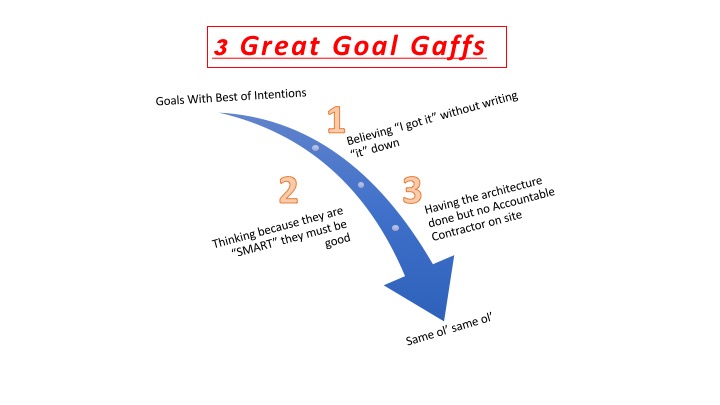
Of course I’m omitting the most obvious, the not having any goals. If you pursue not having goals religiously then it’s pretty clear you are goal minded nonetheless. We’ll concede also that this path of gaffs are on roads paved with good intentions. There are formalized goals processes, staff meetings, authoritative sounding internal communications, maybe forms, and even the “don’t need ’em” camp can be success-minded along with other informal goal setters who have us surrounded by the idea of growth targets, expansion or sustaining at a high quality level. So how do all these arrows of goals end up pivoting and falling back down the path of the familiar? 3 common goal gaffs can be the difference between achieving and succeeding.

BIG GAFF #1, “I GOT THIS”

Intellectual arrogance is the great rationalizer of inadequate actions. By keeping ideas of growth as mind held targets and avoid mandating list of actions, requirements, commitments–things you need to do. Achieving goals isn’t about what you know can happen it is about making happen what set out for by the doing of activities and not settling for the knowing. Key here is you may not have a great Growth Mindset. If you have a fixed mindset then those prejudices and beliefs will guide your actions. Written, Growth Mindset goals help influence the success of those goals.

BIG GAFF #2, DON’T BE STUPID ABOUT ‘SMART’ GOALS

I’m a great believer in the “SMART” acronym, I encourage it of clients and train it to certainly facilitate success. What mistake I’ve seen as a common goal-killer is the sense that having verified ideas through a process and written them so they are success-possible, now let me go work on that. Well the real acronym that accelerates or flatulates goals is “GUOYAAGID.” You’re no doubt familiar with it’s lengthier ring tone, “Get Up Off Your Ass And Get It Done.” No need for an exclamation mark, it is a fact that a Behavior Plan structured with Accountability creates a guideline for the actions that support the results, and the ability to manipulate those towards measurement indicators…well now we’ve got something!

BIG GAFF #3, BIG PLANS, LITTLE OVERSIGHT

In our big government-small government arguments we argue about regulations and oversight, motivations and human nature. The people who succeed translate ideas into action visions and visions into tasks and get them done. You have to make sure the plans are good, people (or you) are skilled and trained and committed to excellence, then pass the tasks along either by delegation or, if you work on your own, delineation. Jobs get done when many parts come together, each tier of effort requires management, whether of personel, resources, investment or time. Each task that is consequential to success needs to be under scrutiny, measurement or observation. Otherwise you can have a beautiful set of drawings for that shiny house on the hill but actually have a long and tedious build among a lot of dull construction mess.

GOALS ARE GREAT BUT…

  1. Make your goals process evident, it belongs on paper (yes, print out your goals if they live in your digital self). Don’t rely on belief you know, show yourself you know and revisit it often. Visualize the result of your goal first but then visualize then document the work to do and you are on path to success and likely finding a Growth Mindset.
  2. Use the SMART process (see my article www.myeurekasolutions/thoughts) but realize that is a goal-setting process, not a goal-achieving process. Be sure to put your well constructed goals into an equally well constructed behavior plan. By documenting what you need to do, when, how many times you will have all the ingredients for the equations of profitability. Then…GUOYAAGID!
  3. It is a rare breed who do not forgive themselves easily out of sheer need of survival. ACCOUNTABILITY is a Bitch! When we know what we have to do and can make a plan to do it we still actually gotta do it. An accountability partner, culture or even a virtual presence of some kind that keeps you to making plans, sticking to plans, and following the measurements of success. Be the one who holds himself above excuses, embraces accountability and finds those targets you started out with might need to be even bigger.

Happy New Year, to a prosperous 2018!!!

Follow Tom at @TomFoxTrainer


Tagged with: , , ,


There are many traits that lead to success in sales, one can argue their rankings as variable, industry relevant, male or female, for new or experienced sellers and there are as many ways to add, slice and prioritize as there are traits to have–or not have. To the extent a salesperson, business owner or deal maker is blessed with many or few success traits or abundance of them or expertise with a few of them surely matters to results. Of all these skills, learned or inherent, however, there is only one number one and the criteria for that is simply that it’s absence, abuse or abandonment makes future success unlikely. That crowns it a cornerstone to a pattern, and even a lifetime of success. What is it? Well as David Letterman might have suggested a while ago, let’s go to the Top 10 List:

TOP 10 SALES SUCCESS TRAITS

10 – Respectful, 9 – Likeable, 8 – Empathetic, 7 – Thick Skinned, 6 – Persistent, 5 – Passionate, 4 – Great Listener, 3 – Client Advocate, 2 – Resourceful…

…And the #1 trait you should have to succeed in Sales…Honesty.

Honesty also happens to be the most likely trait to be absent in anyone’s image of a bad salesperson, followed by pushy, annoying, dumb and the rest of that gang we’ve all known and experienced at some point. Precisely because one’s integrity is most dependent upon the perception of their honesty is why it is the paramount trait for real success. Anyone can lie their way through a sale but liars don’t get referrals and serious liars eventually get numbers under a mug shot.

You should never confuse honesty with weakness whether selling or negotiating, and it surely doesn’t mean taking the prospect’s side in every objection. By walking the wire between what is and what we’d like to believe does sometimes push the honesty boundary with successful people but those who achieve with the intention of deception will ultimately pay with their happiness (in my humble opinion of justice in the universe). So success is more than how much money you make, it is how much joy and satisfaction you have in your life.

There are three top ways a seller can take advantage of their honest intentions:

  1. Unexpected Honesty. This is when you concede to a prospect that there is something better than what you are selling. Tell a person not to buy something from you and the trust you will get back is immeasurable. People always want to buy from those they like and those they trust. Honesty when your sale isn’t their best deal can get you an ally that will easily buy from you when the value proposition is correct or more competitive or recommend you without having bought.
  2. Money Truth. Always keeping in mind that money is completely relative, a hundred dollars to one buyer can be more significant than a thousand to the next. With that in mind you don’t have to agree or convince someone else your price is right but you should use honesty, yours and theirs, to find the way to present value. There is also nothing wrong with making a profit on what you sell so rather than try to hide that fact be prepared to honestly defend it because you earn it. (Chances are practically perfect you are selling to someone who makes money on something they sell.) Finding fairness and advocacy for your price is more easily attained with honesty than by trying to shade and sham around numbers.
  3. The Truth But Not The Whole Truth. Don’t mistake being honest with spilling your guts about every spot on your laundry. You don’t present honesty by overselling it as a virtue. While hiding from reality with a sort of truth is pushing the line honesty does not compel you to be father confessor with every detail, only the ones your client has told you are important or that you realize they should consider as such.

Your reputation is based on your performance and your perception. Of the two your “Integrity Profile” is born. The most successful sellers end up answering their phone for a sale as often as they might dial it. Nothing gets you a positive referral as heartfelt as a reputation for honesty. On top of being able to feel good about what others feel and say about you honesty allows you to recognize pride in your own integrity. No matter how many leads you crack, cold calls you master or big deals you close being able to look in the mirror and know you provided honesty with your sale means you can like what you see, and so can everyone else who agrees to see you.

For more articles by Tom go to www.MyEurekaSolutions.com/thoughts or follow Tom on Twitter @TomFoxTrainer.

© 2017 MyEureka Solutions, LLC

Tagged with: , , , , , ,

Every business owner who gives an annual or a holiday bonus wants it to be appreciated. Give it once and employees feel they are always entitled to it. Should a bonus be seen as a gift or is it earned compensation? The first trick to having this process be both a recognition benefit and an act due appreciation is to clearly establish what it is, how it is earned or granted and a few tricks employers can use to keep this from passing into a privilege to be taken for granted.

ESTABLISH THE RATIONALE

An earned bonus and a gift are not the same thing. It is also okay for a company to have both–or to have neither. What employees disdain is inconsistency and unpredictability. After all, if you were planning your holiday gift budget or a significant personal expense it is smart to understand and anticipate your compensation. Whether it is a bonus or a gift however, there should be a criteria for the giving and the amount. The factors to account, and plan for are: Company P&L, Actual v. Goals, Group Performance, Individual Performance.

A bonus should have more structure than a gift as it is broadly considered to be earned while a gift is more likely bestowed with more emotion. It may make more sense for an annual bonus not to be at year-end. Especially if the company books are closing at year end and if the company income goes to an owner’s personal income tax it should take several weeks to evaluate the factors that would decide a bonus. Certainly these items are better being objective, clear and laid out in advance.

Giving a gift, whether in holiday spirit or recognition for retention can be a little more tricky. If your “gift” is actually a holiday-timed bonus with objective measures less so, but let’s stick with gifts. Current tax laws make gifts compensation a consideration, but like getting a pair of socks when you hoped for an iPhone, the last thing you want is disappointment in a gift. Material items once were more appreciated but having $400 eight hundred thread count bed sheets show up on your W2 is perilous. As ever, cash is king when it comes to gifts. An unintended disappointment is withholding, that may be unavoidable but promoting you are giving a $1,000 bonus and getting a check for $624 is not getting socks, but it’s not a new iPhone either. Here are a few tricks to making gifts have impact:

  • Deliver gifts with a personal handshake, a direct thank you and eye contact. To the degree these are removed or distant expect the impact to be likewise.
  • Think about the net. Taxes are everyone’s burden but if you want to make a connection and give an employee $1,000 then think about making the gross whatever above that so that the net is the number appreciated.
  • Cash or check? It’s not always practical to use cash but think about how you would feel getting an envelope with a pay stub and five hundred dollar bills rather than a direct deposit stub. There’s certainly risk considerations to that but there’s also a “wow” factor so if your situation allows for cash it might be a cooler gift to get.
  • Explain not only the emotion around a gift avoiding platitudes, (“To the best team in the business…”) but link it to the keys that lead to success or perhaps to the shortcomings that might be “if” something had or will happen the opportunity might be even more–or less. Don’t confuse motivation with excuses but a sense of transparency and variability improves understanding and appreciation.
  • Be consistent, to say, “It wasn’t a good year but…” and then gift, suggests that whatever the results the gift is to be expected. Along with that make emotion consistent and genuine. A $500 gift may be as appreciate as an $800 gift if it is presented appropriately.

Whether you are giving an earned bonus to be congratulated or a holiday bonus to be disbursed with thanks, either way compensation and recognition are intertwined. Having a sincere commitment as the giver and being able to express it is the best opportunity to have the receivers appreciate the intent. As in almost all employer-employee interactions the amount of success is proportionate to the quality of communication.

Happy Holidays.

© 2017 MyEureka Solutions LLC. Follow Tom on Twitter @TomFoxTrainer. Read other articles on business leadership, sales and management at www.myeurekasolutions.com/thoughts.

Do you give or get a bonus or holiday gift? Share this with anyone giving that might want to see it being appreciated rather than taken for granted.

Tagged with: , , , ,


I had a recent client find his Eureka idea, “I had no idea how much of sales is about psychology.” I’m happy to quote the father of my former franchise David Sandler who said that selling is a Broadway play performed by a psychiatrist. Sales professionals have long known, by training or by instinct that psychology is fundamental to success. There are 3 aspects of sales psychology that correlate to 3 super-steps of sales but there’s also often an end point that can supersede psychology.

Before we get to the end point let’s identify these rule of three players. The overview 3 parts of selling are 1) Qualifying a prospect, 2) Discovering needs, value and fit and 3) Closing and delivering. Obviously there are many sub-steps to each of those, (including our 3 Agreements™process) and psychology has many corresponding miens in those steps but to think about where human behavior science as a sales process goes there are also 3 fundamentals…

Psychology #1: The Seller Brain

The starting point for anyone who has to sell to consider lies between their own 2 ears. How you see yourself dictates how you will act. Do you fear rejection or confrontation? Do you crave approval? Is procrastination your rationalization to avoid what you fear or dislike doing? Can you see yourself as an equal to your prospect or do you assume a subservient or compliant posture at the first sign of conflict? Before anyone learns how to use psychology to influence others they must face their own inner psyche and how it influences their goals, dreams and behaviors.

Psychology #2: The Buyer Mindset

Every prospect brings their experience with both buying and selling to any sales discussion. Do they see themselves as above any seller, that their time is more valuable and that they are suspicious of professional salespeople? Even open minded and fair people however, can have very different feelings and attitudes about money, value and making or sticking to decisions and commitments. They key for successful sellers is to discover those feelings, thoughts, prejudices and vulnerabilities in their prospect and understand how to utilize or counter their profile. Sales is so hard because people have a multitude of combinations of fears, anxieties, trust preconceptions and many aspects can be hidden, guarded or subdued and worse, people come to believe their own lies.

Psychology #3: Sensitivity To Emotion

The psychology of emotion is a huge factor in professional sales success. While many transactions can be cut and dry, needs and services can align where surface value and facts make sales. But, for most sales where you have to get an audience, cut through competition, help a buyer see why he needs you and make your offering a priority to be acted and a commitment to be made and honored psychology the grease on those wheels is emotion. When the first two aspects of psychology are conscious and directed then the techniques to convert facts to fears, opportunities to devotion and drive inaction to action are about the skill to use psychology to steer those conversions and change talk to money.

The Brain-Behavior Limit

There are sellers who are great at understanding the psychology of selling and it expedites their success. The real good ones are also great closers and psychology can be a part of that too whether it is in unearthing hidden decision makers or dealing with buyer’s remorse in advance they close with the science of the mind. I concede however, there also successful sellers who, quite frankly, are bulls in china shops when it comes to mental processing but they have enough personality and persistence to close. Likewise, there are those sellers ripe with empathy who lack enough of the killer instinct to make sure their efforts end in a contract or getting a check.

Whether your job is professional seller or you are in a position as an owner or a senior executive where no matter what your “other” responsibilities you still have to sell, it is highly worthwhile to understand, and attempt to master, an understanding of how psychology influences purchasing and get the techniques and actions that facilitate it. Otherwise, you can always try that hungry lion approach and keep hunting until you get to eat what you kill. Then again, enough of both probably puts you at the top of the class.

© 2017 MyEureka Solutions LLC. You can find Tom’s articles on LinkedIn or at www.myeurekasolutions.com/thoughts. Follow Tom on Twitter @TomFoxTrainer.

Tagged with: , , , , ,
Tom Fox